Countdown

Thursday, November 4, 2010

Shave Ice

Shave Ice is a Japanese dessert that was introduced to Hawaii when Japanese plantation workers immigrated to the islands and brought it here a long time ago.  It is NOT the same as a snow cone, though many people equate the two.  Shave ice is an ice-based dessert made by shaving a block of ice. While the product can resemble a snow cone, snow cones are made with crushed, rather than shaved, ice.  Snow cones on the mainland are made with crushed ice and fruit syrup, and are often re-frozen so that when you get them they're pretty much one chunk of flavored ice. Shave ice, on the other hand, is actually shaved off a big block right in front of you into a fine powder so it's easy to eat. Then it's topped with any one of countless exotic tropical fruit flavors. Shaving the ice block produces a very fine "snow" with an extremely fine texture.  It's nice because the syrups added to it are absorbed by the ice rather than simply surrounding it.  If you've ever had a snow cone, you know the flavored syrup can actually be sucked out of the ice, leaving just a giant ball of ice with no flavor.


Hawaiian shave ice is traditionally served "rainbow" with three flavors and with a scoop of vanilla ice cream on the bottom.  You can also get sundae shave ice with hershey's chocolate syrup or shave ice with mochi balls and/or azuki beans.  There are countless options.  There is a debate among locals here about which shave ice location is the best.  There is Matsumoto's on the North Shore and Waiola's near the University of Hawaii. A quick Google search will yield a variety of reviews.  I think it's safe to say that Matsumoto's is the most famous, but I think Waiola holds the title of "Best Kept Secret."


One reviewer had this to say about Waiola:  
my favorite shave ice ever. the softest, finest, smoothest shave ice. and i've been eating this for so many years, well before their now fancy schmancy colorful signs!  To me, it's way better than Matsumotos, Aokis, Ice Garden, and the rest of the list.

Sundae Shave Ice from Waiola's
 Another reviewer thought Matsumoto's was the best:
This place is absolutely amazing. I was told it was a must in northshore and who ever told me this, he was right! The shave ice can't be more perfect. The presentation was amazing, the taste was really good, and the price was really affordable. It was worth all the driving.


I have not had Matsumoto's yet.  I live around the corner from Waiola, though, and had my first ever shave ice experience the other day.  Have you ever had something ruined by unreasonably high expectations?  Welcome to my shave ice life.  Everyone told me how amazing shave ice was.  Then they told me that the BEST shave ice on the island was Waiola (to be fair, I think there is a rivalry between the North Shore crowd and the Honolulu crowd with the former recommending Matsumoto's and the latter recommending Waiola.).  So I go to the window and order the Sundae Shave ice.  I get it with Strawberry, Vanilla, and Chocolate.  It came with Hershey's syrup, condensed milk, and a little ice cream.  It was definitely good.  We ate the whole thing (note: these are big enough to share!).  However, I was expecting an explosion of flavor to overwhelm my tastebuds such that I was temporarily disabled with orgasmic sensations.  No such luck.  It had a weird texture.  It was like rating flavored snow.  It was refreshing and unique, but not quite as good as ice cream.  As for price, it was about what I expected.  For a bowl large enough for two, it was $4.50.  I have heard Matsumoto's is cheaper, but then again you have to travel to the North Shore.

Of course, this is just my first impression.  I only had one kind of shave ice (sundae bowl) from one place (Waiola).  It was definitely good enough to have again and I will continue to experiment with different flavor combinations as well as different vendors.  I may even venture a trip the whole 48 minutes to the North Shore to sample Matsumoto's (maybe I'll even buy an over-priced t-shirt).  

Wednesday, November 3, 2010

My Gripe With Legalization

Marijuana is still illegal to possess without a prescription in California as voters rejected Proposition 19 by a 54% to 46% margin.  Maybe the potheads just forgot to vote.  I can just see a bunch of people with "anxiety disorders" sitting around, partaking in "herbal therapy" watching TV and saying..."Dude, Prop 19 didn't pass...uh...dude, did you vote?"

Proposition 19 was California’s ballot initiative to legalize marijuana possession and use for adults over the age of 21.  It would allow people over 21 to produce and sell marijuana “in small amounts” (whatever that means).  In Hawaii, marijuana is decriminalized.  Here is a brief explanation of Hawaii’s policy.  If you want to look up your State, here is a State by State index

Advocates of legalization believe that legalization will generate a major budgetary windfall and unleash an economic boom in marijuana-related industries while reducing crime, corruption and Mexican drug violence.  Legalization would be a significant change in that marijuana production and sale would move above ground. State and local governments could then tax it. California is expecting $1.4 billion in additional tax revenue from legalization, along with reduced criminal justice expenditure.  Opponents argue that legalization will increase marijuana and other drug use via the gateway effect and spur the alleged negatives of use, such as crime or diminished health.

Look, if you wanna get high, who am I to stop you?  On one hand, there is some validity to the legalization movement (the hippie advocates aside).  Yes, there is no question that legalization of marijuana would allow States to tax it.  Yes, it would reduce burdens on the courts and prosecutors who go after dealers or users with small amounts of pot.  Enforcing marijuana prohibition costs taxpayers an estimated $10 billion annually and results in the arrest of more than 847,000 individuals per year.  Yes, marijuana is probably less dangerous than two other, more popular drugs - tobacco and alcohol.  Around 50,000 people die each year from alcohol poisoning. Similarly, more than 400,000 deaths each year are attributed to cigarette smoking.

My problem with the legalization movement has less to do with legalization in principal and more to do with the practical effects and unintended consequences that seem to be too easily dismissed by its advocates.  First, if I choose to grow a small amount of marijuana in my room at home, how in the world is the government going to tax that?  Currently, I am a beginner homebrewer.  The government doesn’t tax the beer I make.  Second, what about industrial suppliers.  Where do people think marijuana is going to be grown?  I don’t foresee a burgeoning farming operation developing in the U.S.  Rather, suppliers will come from Mexico where operations currently exist in vast quantities.  Additionally, how will Mexican drug cartels react to legalization in America?  Will they simply charge less than legal U.S. suppliers creating a more attractive black market?  If it's legal to possess, how can anyone be upset how you obtain it?  I suppose one upside would be that all the illegal Mexicans currently in the U.S. might stay in their own country with so many new, legal jobs being created, right?  The ability to regulate this new market seems poorly thought out.  It seems more like a bunch of hippies who just want to be able to smoke themselves stupid while California is just looking for a quick fix to its budget crisis without thinking through the consequences.  Third, marijuana use impairs a person’s ability to drive a car, just like alcohol.  However, there is currently no effective way for police officers to test for marijuana impairment at traffic stops.  How can police officers effectively stop stoners from causing accidents on the road and putting people’s lives at risk if they can't test for it?  Fourth, has anyone considered the costs of rehab?  The U.S. currently spends millions of dollars in alcohol abuse rehabilitation.  Logically speaking, won’t the same be necessary for marijuana abuse?

While I certainly appreciate the legalization movement’s purported commitment to helping the country with its budget crisis, I am not convinced that it is anything more than an effort to get the cops off the backs of hippie patchouli wearers.

Dragon's Nostrils and Makapu'u

Makapu'u Lighthouse is one of Hawaii's most familiar landmarks along the Windward (Southeast) side of O'ahu. It is actually on the South Easternmost tip of the island.  The lighthouse was built in 1909 and automated in 1974.  There is a 2-mile paved trail that leads to the lighthouse and along the way has a fantastic view of the entire coastline and the island of Molokai in the distance (The Molokai Channel runs past Makapu'u Lighthouse).  A little over a mile up the trail, there is a "whale watching plaque."  This plaque talks about Humpback Whale watching that is supposedly spectacular from this viewpoint during their mating and birthing seasons from December through April.

Getting there is really easy.  From Waikiki take Kalakaua Avenue past the Honolulu Zoo and Kapiolani Park. Turn right onto Diamond Head Road. Follow the signs going East (to your left) to Kalanianaole Highway (Route 72). You can also just jump on the H-1 East and stay straight.  H-1 turns into 72.  You'll pass Hanauma Bay (closed on Tuesdays, so no review yet), Sandy Beach Park, and the Halona Blow Hole until you get to the Hawaii Kai Golf Course. About ½ mile past the golf course, the entrance to the trail is on the right.  You'll also likely see about a half dozen paragliders gliding in the air above the mountains.  This is where all the hang gliders and para gliders come to jump off.

The hike is fairly easy, though it can be a little steep and it's 2 miles long.  You don't have to be in great shape to walk it, but definitely bring water.  We forgot (mostly because we didn't expect to be hiking at all, but just sort of stumbled on it) and by the end you're desperate for water.  Also, make sure the tide is UP when you go.  Going back to the whale watching plaque.  The trail follows the coastline, so you get some great views of the water along the way.  If you stop at this plaque, though, look down the 400 ft cliff.  The entire cliff wall is dried lava.  It will slightly slope down to a lava bed just out into the water, but still attached to the land.  If the tide is up, you'll notice the "dragon's nostrils."  The ocean has somehow carved holes and caves into and under the lava. When the water rushes underneath, the air and water are pushed under the lava and violently shoots through the blow holes (about 4-5 of them).  Well, there are two holes right next to each other that quite accurately depict a dragon's nostrils.  The sound is incredible and the geysers shoot easily 25 feet in the air.  You can hear it and see it from the trail even though it's about 350-400 feet down the cliff.  You may even see people swimming in the wading pools around there (see below).


It is a 400 ft hike down the lava cliff to the pools.  The trail to the Dragon's Nostrils (if you can call it a trail) starts near the whale watching sign. It is more of a scramble up and down. There are white arrows painted on the rock, but you can't really see them until you are on your way back up. So going down is kind of a guess if you haven't done it before. As you're climbing down the cliff trying not to fall to your death, lava rocks are loose and slipping under your feet.  This part of the hike (which is NOT on the paved trail) requires you to be in good shape (and to have a strong sense of adventure).  Getting down the cliff took us about 35 minutes or more.  It's slow and finding the trail down is next to impossible.  So we climbed/crawled down, took some pictures and video, waded in the pool with some locals (though, if I live here now, do I get to claim local status?), and tried to admire the sheer size of the cliff we just descended (and tried to get over the loud sound of the nostrils).  It sounds like there is a giant T-Rex caught or trapped underneath the lava shelf just itching to escape and attack anything in sight.  Pretty cool stuff.

Beer Reviews and Yardhouse

I am conflicted.  Yardhouse - Waikiki is a great bar/restaurant but has its flaws.  On one hand, it has dozens and dozens of beers on tap with a choice for everyone's palate. On the other, it's in the middle of a tourist hotbed, which means the bar is almost always too crowded, the food is average, and the prices are a little expensive.  The only real appeal of this place is its vast beer selection.  So it's a great bar/restaurant to visit at certain times.  This weekend, I discovered some new information.  Yardhouse has happy hour after 10:30pm from Sunday through Wednesday (no work on Tuesday for election day made this information easier to discover).  The bar also has happy hour from 2-5:30pm Monday through Friday.
Half the Beers on Tap
Happy Hour at Yardhouse includes $3.50 and $4.50 pints (domestic and import), which beats their normal $5 and $6 prices.  Martinis are $6.25, Wine is $1.25 off, and apppetizers (including 6 types of pizza, onion rings, egg rolls, chicken fingers, buffalo wings, sashimi, etc) are half off.  If you're planning a trip to Honolulu, and you like beer, I highly recommend stopping in to Yardhouse during Happy Hour.


As for my beer reviews, I was with several people this weekend and got a great sample of delicious beer.  Here is the list and a brief description/review, in no particular order.  If you want to see ALL the beer offered at Yardhouse, here is a copy of their menu (this does not include everything, but it still gives a good sampling).


Kona Longboard Island Lager - This is the Kona Brewing Company's flagship beer.  Kona is a small micro-brewery located in Kona, on the Big Island.  The company introduced Pacific Golden Ale (now called Big Wave Golden Ale) and Fire Rock Pale Ale on February 14, 1995. Longboard Island Lager was added three years later. Longboard is a smooth beer very similar to a Stella Artois.  It has a delicate, slightly spicy hop aroma that complements the malty body of this beer.  It's a golden pale color that can be sipped all day on the beach.  Go into any bar/restaurant in Hawaii and they'll serve Longboard.


Kona Wailua Wheat - Light citrus wheat beer made by the Kona Brewing Company here is Hawaii. Here's how the company describes it: "Swimming in a fresh water pool at the base of a cascading waterfall is what we all imagine we would find in paradise.  On Maui, follow the old Hana Highway and you will find such a place – Wailua Falls. This plunging cascade of clear water is the inspiration for our Limited Release Wailua Wheat Ale. This golden, sun colored ale has a bright, citrusy flavor that comes from the tropical passion fruit we brew into each batch."  I couldn't agree more.  This beer is easily on of my favorites.  If you like lighter beer with hints of citrus, this is your beer.


Pyramid Audacious Apricot - Another fruity beer.  The difference between this beer and Wailua Wheat is the power of the fruit flavor.  Wailua Wheat has a distinct, but light citrus flavor that is refreshing.  This is a smooth, mild wheat ale, unfiltered and 5.1% alcohol by volume, garlanded with a pure, sweet apricot note. The apricot part makes it a little hard to match with foods, but if you're looking for a cheesecake beer (or a custard beer), here's your brew.  The Pyramid Brewing Company's Apricot beer is refreshing for the first half pint.  After that it becomes a little too sweet. Overall, it's good, but not as good as Wailua Wheat when it comes to fruit beers.


Young's Chocolate Stout - This one is making a run at being my new favorite beer. This is a thicker Stout beer with a hint of chocolate aftertaste that can even be used to make a Beer Float with Vanilla Ice Cream (available at Yardhouse).  It's made with pale ale and crystal malt, chocolate malt, special blend of sugars, Fuggle and Goldings hops, real dark chocolate and chocolate essence.  Chocolate malt and real dark chocolate are combined with Young's award winning rich, full flavored dark beer to craft a satisfyingly indulgent, but never overly sweet experience.

Young Double Chocolate Stout - One of the few times in my life where I'll say a single is better than a double.  The double chocolate is too thick and sweet with not enough beer bitterness.  First, it comes in a smaller glass, presumably because the high amount of sugar fermented by the yeast yields a higher alcohol content.  This did not have nearly as much character as the Single Chocolate Stout and did not go down nearly as smoothly. I can see using this in the Vanilla Ice Cream Beer Float, but beyond this, it wasn't even a good dessert beer.  The chocolate was actually closer to baking chocolate (i.e. bitter) than the single's bitterness finished with a sweet and smooth finish.  Not really a fan.

Rogue Dead Guy Ale - This is a really great ale beer that, while having a strong hoppy flavor (bitter), it finishes smoothly and with a hint of fruity/sweet undertones.  Someone else said they caught a hint of cloves. It pours a hazy, pale amber/orange with a tall white head that lasts for a decent amount of time.  Fun fact: In the early 1990s Dead Guy Ale was created as a private tap sticker to celebrate the Mayan Day of the Dead (November 1st, All Souls Day) for Casa U Betcha in Portland, Oregon. You could easily drink this beer all night.
The Pipes Keeping the Beer Cold

Monday, November 1, 2010

Kailua Square Shopping Center

On the way to Kailua Beach and Lanikai is the fairly cool Kailua Square Shopping Center.  It has a "Book Ends" bookstore with old and used books (as well as some new ones).  It has Mexican and Vietnamese Restaurants for lunch, two organic baby stores (they sell clothes made from organic cotton...insert sarcastic, judgmental comment here).  They also have a Lanikai Juice.  Now I've mentioned Lanikai Juice before as the place to get Acai (A-SIGH-EE) Bowls.  Here is a sample menu.  I always get the Extravaganza with no bananas.  The extravaganza comes with double acai, banana, apple juice or soy milk, and granola, topped with strawberries, mango, blueberries, and shredded coconut.  You can substitute anything.  You can also add honey for an extra $0.70.  These bowls are easily big enough to share and run about $9.  Definitely worth your time to stop in.


There is also a Kayak shop across the street from Lanikai Juice, next to the Napa Auto Parts store.  The kayak rentals are about $5-10 cheaper than the trucks near Kailua beach ($45 and $55 - half and full day).  If you plan to drive to Lanikai anyway, it's definitely worth stopping here to rent your kayak.  You can rent single or tandem kayaks at either place.  The shopping center also boasts a Terry's Burger place, a starbucks, bead shop (I guess there is a market for little girls who make jewelry?), bakery, grocery store, drug store, and other interesting places that are worth walking past while eating your acai bowl.

Kayaking in Lanikai

As I mentioned in my "Lanikai and Laird Hamilton" post, there are two Mokulua Islands about a mile off the shore of Lanikai and Kailua.  It cannot be overstated enough how Lanikai is a picturesque beach that seems like it was plucked right from a postcard.  Crystal clear water, white sand beach, two islands offshore, gorgeous houses along the beach, and a mountain range in the background.  While I recognize that I have not been to too many beaches here, Lanikai is so far my favorite.  It definitely beats the crowds (and dirtiness) of tourists in Waikiki.  There is a reason Oahu's Kailua Beach and Lanikai Beach have been voted best in the U.S. for swimming, walking, kayaking, windsurfing, boogie boarding, paddling, snorkeling and a number of other water sports.

The Mokulua Islands are two bird sanctuaries now, but the one of the left also has a beach that is littered with kayakers and beach-goers who pack lunches and just hang out.  This weekend I decided to try kayaking out to the islands to see what they were all about.  To get to Kailua Beach Park is fairly simple.  If you're leaving from Waikiki, you simply take the H-1 (Interstate) Highway to the Pali Highway.  Stay straight on the Pali for 9 miles until you get into the town of Kailua.  The road eventually forks, but stay straight (left) on Kailua Road.  You'll pass Kailua Square (Aikahi Park) Shopping Center and Macy's.  Keep going all the way to the end of the road until you can only turn left or right. Turn right onto Kalaheo Rd. You'll pass some kayak stands on the right and the Kailua Beach Park parking lot will be on your left.  Keep going straight and you'll run right into Lanikai in about 2 minutes.  There is no parking lot in Lanikai, but you can park your car anywhere you find a spot.  Everyone just parks along the side of the road and you'll know you're in Lanikai when you start seeing all the cars parked along the road.
  
This weekend I decided to kayak out to the Mokulua Islands.  I did not have any recommendations for my first time, so as I get more experience, I'm sure I will update my thoughts.  A protective barrier reef allows for easier paddling and a chance to kayak from Kailua Beach to the Mokulua Islands, Flat Island and Lanikai Beach. When you kayak in this area, you go through sea turtle feeding grounds, sea bird sanctuaries and living coral reef, all with the majestic backdrop of the Kololau Mountains. Be prepared to see the native Hawaiian Green sea turtle, or Honu, tropical fish and other marine life in their natural habitat.  We actually saw a sea turtle and it was pretty awesome. 
  

I have been to Lanikai a couple times prior to this weekend and there is nowhere to actually rent kayaks in Lanikai.  So if you think you might want to kayak, plan ahead.  You have to rent kayaks, windsurf boards, etc. from Kailua, which is the beach park right before you get to Lanikai.  Along the side of Kalaheo Rd you'll see a bunch of trucks with dozens of kayaks.  That's the only spot you can rent them near the beach.  These trucks are actually the satellite operation for several shops in downtown Kailua.  Renting a tandem kayak for half a day (4 hours) will cost $50-55 (total for 2 people).  Renting for a full day is $65-70. ALWAYS ask for the Kama'aina Discount, though!  It reduces the price by about $10.  Also, they are not sticklers about time, so always get the half-day.  They DO NOT care if you come back in 5 or 6 hours.  This goes for all rentals - surfboards, kayaks, etc.  

One thing you should know is that these truck vendors CANNOT accept cash.  It is a violation of park ordinances to accept cash in the beach park.  If you want to pay cash, you'll have to go back into town to the actual shops, which is annoying.  For people wary of giving your credit card number to guys on the side of the road, though, this may be worth the security.  Know this, though: some people operate illegally.  There are guys who accept cash.  If someone is willing to accept cash, then they are not affiliated with any of the shops in town and are actually despised by the legitimate businesses. However, their kayaks still float.  Further, knowing that they operate illegally is to your advantage.  They will still try to charge you the same rate as the legitimate businesses, but you have all the leverage if you know the rules.  You can easily talk them down to $30 or $40 depending on how confident you are.  No matter who you rent from, they'll help you tie it to your car.  

A picture from the island...this is how far you'll kayak

If you don't want to do this on your own, you can always get ripped off  try a guided tour.  For $95 (each; $190 for 2 people), you a get a 4-hour "eco-tour."  This means you follow someone through the turtle feeding grounds and have them explain what you're looking at.  The tours usually include some kind of snack and 2 hours on the beach.  If my stellar recommendation has you interested, I've heard that Kailua Sailboards and Kayaks are a good bet.  You can also try Hawaiian Water Sports.
   
Now that you've tied the kayak to your car, drive to Lanikai.  Don't try to Kayak from Kailua Beach to the Mokulua Islands.  It's far and not worth the added hassle.  Drive all the way through Lanikai.  Lanikai is a giant loop.  As you get into the town, it goes off the right.  Drive until it comes back around and park right there.  You'll see the beach access point.  This is the shortest distance to the Islands.  Now, the two islands don't seem too far offshore.  Originally, I thought even an average swimmer could easily swim the distance.  I was wrong.  When you're in the middle of the water and have been paddling for a half an hour, you realize that those islands feel like their the disappearing Island in Lost.  It just keeps moving further away.


When you finally make it, the islands create a weird tidal shift.  Waves some in from both sides of the beach and converge to make for a tricky landing.  If you're not careful, you could tip over.  This isn't disastrous as the water is knee-deep.  It's just embarrassing because the beach is filled with people who kayaked over and they're undoubtedly judging you as both an amateur and a tourist.  The trick is to know that the waves are there and just be prepared to paddle through them.  Pack a lunch.  It is pretty cool to see everyone on the island just hanging out.  Some guys were playing horseshoes and drinking beer when we showed up.  Other people had lunches and were lounging on towels.  Still others were snorkeling.  People brought their kids (no dogs are allowed on the island).


While the island is definitely an adventure and off the beaten path a little, it's not that relaxing.  The beach is not that big and it feels crowded because of its size.  There were maybe 50 people on the entire island, but with everyone so close together, it felt like more.  If you don't really care about kayaking and you're really just in the mood for a quiet, relaxing lunch on the beach, skip the hassle of getting to the island and just sit and enjoy Lanikai.  There is nothing to see on the island so the real appeal is just saying you did it (which, admittedly, is cool).

Here’s what to know before you go:


  • You don’t need to be super fit to kayak Kailua Bay, but you do need to be in relatively good shape and have the ability to swim without a personal flotation device. Note that PFDs were provided.  We didn't wear them.
  • You must 13 or older.
  • If you take one of the guided tours, the company will provide transportation to and from Waikiki hotels. You should drive your own rental car, though.
  • Snorkel equipment is provided if you ask.  It's free.
  • Wear sunscreen!
  • Wear sunglasses.
  • Wear a hat or visor.
  • Bring a waterproof camera.
  • Wear your bathing suit
  • Don't bother taking a guided tour.  Rent your own kayak and relax and have fun.

Halloween in the Pacific


Halloween is a big deal in Hawaii.  They say the freaks come out at night – and no more so than on October 30-31 (see right).  When I first moved to Honolulu, in August, people were already talking about it.  What costumes they were planning to wear, how creative they were going to be, how important it was for me to be creative, how much alcohol they planned to consume, and which bars they planned to shut down.  As it got closer, the Halloween talk intensified.  No one could seem to decide whether they were going to go to Waikiki or Chinatown.  Waikiki was the place to show off costumes, roam the streets, and just “cruise.”  Chinatown, on the other hand, was the location of Three Nights Of Pleasure In Paradise.


Hallowballoo involves shutting down the streets of Chinatown.  Beer and wine stands line every sidewalk.  Bars and clubs open their doors until 4am.  Over 26 Bands and Musicians play over 3 days.  There are homemade costumes, store-bought costumes, and “what the hell is that” costumes.  Everyone uses the opportunity to dress in ways they would never dress in front of their grandmother.  People stop each other on the street and ask to take pictures with you because they like your costume.  It happened to me a few times and I wasn’t even that creatively (or provocatively) dressed.   Old people get into the act as well.  I saw at least a half dozen 70+-year-olds in full costume…capes, masks, cat ears, devil horns, magic wands, etc.


I have a theory as to why Halloween is a big deal here.  Another nice thing about keeping a blog is the opportunity for me to engage in one-sided pontificating without the fear of having my half-reasoned logic exposed for what it is.  Anyway, it seems that a lot of people who live in Hawaii are running away from something on the mainland.  Allow me to explain.  If you take a random sample of people who moved to Hawaii (i.e. not Native Hawaiians), you will get one of three responses: (1) why not?; (2) I was just looking for adventure and I figured Hawaii was as good a place as any; (3) I just sort of bought a ticket and ended up here.  It is a rare person who actually arrived here with any semblance of a plan.  Now, you may be thinking that these are just free-spirited people (read: hippies) who aren’t necessarily running away from something.  Continue talking to them, then.  If you continue to engage the person, you will discover that 8 out of 10 times the move to Hawaii followed a divorce or break-up, recent graduation from college with no life plan, a fight with mom and dad who said they were no longer willing to pay the bills, a fight with roommates, or the loss of some really revered pet.  Okay, I made the pet part up, but you get the point.  Oftentimes, people move here because they have no plan and nothing back home.

   
I classify these people into a category of those with “broken personalities.”  For example, everyone here is covered in tattoos.  I’m not talking about one or two tasteful tattoos in fairly discreet locations.  I’m talking about full-on, full sleeve tattoos that cover significant portions of visible skin.  In general, a tattoo is a way of turning your body into an advertising placard that uncovers the person’s inner personality.  

Consider this: Psychiatrists from the Michigan Center for Forensic Psychiatry studied 36 male inpatients, and found a link between tattoos and antisocial personality disorder. "Our findings suggest that patients with tattoos are significantly more likely to suffer from antisocial personality disorder than those without tattoos, and patients with antisocial personality disorder were also significantly more likely to have higher numbers of tattoos, a larger percentage of their body covered with tattoos, and tended to have tattoos in more visible locations" said lead researcher Dr. William Cardasis of the Michigan Center for Forensic Psychiatry.


Now that I have established the premise, here is my rant on Dressing Up for Halloween: 

Halloween is when people take the opportunity to pretend they’re someone else for one night.  You can hide your face behind a mask and/or make-up.  You can dye your hair.  You can reveal far more skin than is socially acceptable on the 364 other days of the year (both men and women).  You can parade around in a ridiculous costume and ask everyone to admire your “other self.”  You can comfortably draw attention to yourself and ask everyone to admire you in all your hidden/broken glory.  It allows people the opportunity to masquerade and hide from their otherwise boring and uninteresting life. 


That was Saturday.  Sunday was actually Halloween.  Waikiki was just as out of control Sunday as Chinatown was on Saturday.  I went to Yardhouse for some pre-dinner beers (see Beer Reviews for some descriptions).  One cool thing was the number of kids trick-or-treating at all the Waikiki shops.  Each store had hand-written signs on the storefront window that said, “trick-or-treater welcome.”  Kids were run into the stores, say trick-or-treat, and be rewarded with handfuls of deliciousness.  There were several bands playing outside of Yardhouse and the streets were absolutely packed with hordes of costumes.  It was pretty tame and pretty entertaining, and this was all before 9pm. 

So if you love Halloween and are planning a trip to Hawaii, it’s definitely worth your time to coordinate the two.

Friday, October 29, 2010

Trial Practice at University of Hawaii

Prior to this morning, I thought the University of Hawaii law school did not offer its students a Trial Advocacy class.  I was wrong.  They do.  They offer a class in both the Fall and Spring semesters.  What does that mean for my goal of teaching trial practice at UH?  Well, it certainly doesn't make it any easier.  However, I took the first step in getting involved today.  There is a different professor each semester so I contacted both of them.  The current semester is almost over so they don't need any more help right now.  I figured that would be the case and so didn't have high expectations, anyway.  However, my conversation with the second professor went decidedly better.

First off, he graduated from my alma mater - George Washington Univ.  He also got his Master's Degree there before going to law school at Berkeley.  He was much more willing to talk to me when he found out I was a fellow Colonial.  So we discussed the format of the Trial Practice class, the textbook and case file they use, and where he thought I could be of some assistance.  It sounds like I wouldn't be useful all that often, but on certain weeks I will come in, play a witness, and provide feedback to the students.

Essentially, it sounds like they have a much smaller class size than what I had in mind and they are not nearly as thorough as I would have expected, but it still sounds like a class I would enjoy participating in.  The spring semester is co-taught between a civil litigator and retired judge.  The civil litigator is the one who pretty much runs the program and is also the GW alum I talked to.  He said they use one case, which he tried himself years ago, and they stick with that case all semester.  They take the case from start to finish, including voir dire of a jury at the beginning.  Then they do weekly assignments for learning how to do directs, crosses, opens, closes, etc. They also have certain people come in who have been witnesses in trial and give a lecture on witness preparation.  Overall it sounds like a great experience if I can get involved.  

In the interest of fairness, I should say that I rail on GW as a school all the time.  I constantly say that they have a horrible alumni network and the school was (and probably still is) worthless when it comes to helping its students or alums with...well...anything.  They were terribly mismanaged when I was a student and the President (who has since retired) was a money-hungry ass who didn't give a damn about the students.  If this guy actually lets me take part in his class, even if it's not because I am a GW grad, I am willing to be at least a little nicer about other grads from now on.  We'll see.

Wednesday, October 27, 2010

Growing a Pineapple From It's Top

Planted October 1, 2010
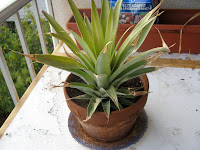
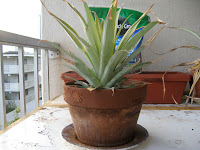
This weekend I decided to grow a second pineapple.  I discovered a couple problems with the first one.  First of all, I forgot to actually blog about the fact that I planted it.  Sure, I talked about soaking it, but anyone actually paying attention (yea yeah, a stretch, I know...relax), would think the damn thing has been soaking for the last month.  Well, it was planted on October 1st.  That brings me to the second problem.  When I planted the first pineapple, I planted it in old dirt that has been sitting on my lanai (back porch) for the last month.  There were several garden pots already on the lanai when I moved in.  These pots had dirt in them already, and at the time, I didn't have a chance to go get potting soil, so like MacGyver, I just used what was available.  Now, I may not know a whole lot about gardening or planting pineapples, and maybe old dirt that has been caked in clay pots for God-knows-how-long will be fine, but I assume fresh potting soil is better.  The third problem is that I never bothered to take a "before" shot and it's going to be pretty difficult to measure any change without some context.  Well, here are two pictures of the first pineapple (taken 3 weeks later...oops).

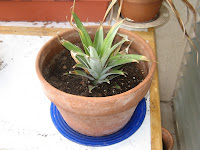
This weekend, however, I happened to pass Home Depot and stopped to get potting soil so I could plant a second pineapple.  I assume using potting soil will better promote pineapple growth than old dirt (at least that's what the Miracle Grow bag says and I doubt the fine people at Miracle Grow would deceive me!).  Anyway, since I had plenty of pots, I figured I could compare the second pineapple with the first one.  After all, if I am going to blog about my life in Hawaii as it parallels the growth of a pineapple (I also just considered how ridiculous that sounds when you say it out loud), I wanted to document the pineapples' growth a little more "scientifically."  All this really means is I plan to take pictures every 2-4 weeks and measure the leaves to report any changes (or lack thereof).

Planted October 25, 2010
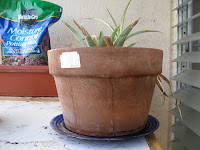
At present, there are two pineapples growing on my lanai.  The second one (pictured to the left) was planted on October 25, 2010.  Interestingly, I think the first pineapple that was planted has actually grown a little in the last few weeks.  Since I forgot to actually blog about the fact that I planted that one, I guess we'll just have to go with "it looks bigger" (insert 'that's what she said joke here').  The second pineapple is growing in a medium-sized pot that will probably be sufficient throughout the growing process.


Planted October 25, 2010
Now, to give you a better sense of what growing a pineapple entails, I included a YouTube video of a guy going through the process (below).  I watched a few videos and despite this guy's "weird" personality, this was the best one.  Unlike in the video, however, I chose to soak my pineapple for a couple days prior to planting.  Soaking the pineapple stem allows the roots to sprout a little more fully.  I soaked the first pineapple for about a week.  The second one I soaked for only 3 days.


Tuesday, October 26, 2010

Oral Arguments

With all the posts about hiking, drinking, beaches, and furloughs, it is quite easy to forget that I actually have a job where I am expected to read legal briefs and help a judge render his decisions.  In reality, my work schedule is more intense than one might think.  I am at work usually by 7:15am and I leave work around 5:30pm.  Now, in the interest of full disclosure, it's not exactly an "intense" work day.

Occasionally, however, my job requires some actual attention.  Take this week, for example.  I got a case a little over a week ago (maybe 2 weeks ago...it's so easy to lose track of time when procrastinating so much).  Anyway, the case involves a fairly close question about adhesion contracts, the infancy doctrine, and whether a person has to forego a judicial forum and submit the case to arbitration.  For anyone who may potentially read this who didn't go to law school, a contract of adhesion is drafted or otherwise proffered by the stronger of two contracting parties on a ‘take it or leave it’ basis. In other words, the terms of the contract are imposed upon the weaker party who has no choice but to conform.  Contracts of adhesion are unenforceable if two conditions are present: (1) the contract is the result of coercive bargaining between parties of unequal bargaining strength; and (2) the contract unfairly limits the obligations and liabilities of, or otherwise unfairly advantages, the stronger party.

Under the infancy doctrine, a minor may, upon reaching the age of majority, either ratify or avoid contractual obligations entered into during his or her minority.  The infancy doctrine is based on the idea that the law should protect children from the detrimental consequences of their youthful and improvident acts.  The rule that a minor's contracts are voidable is not absolute.  An exception to the rule is that a minor may not avoid a contract for goods or services necessary for his well-being or growth.  Contracts for “necessities” (i.e.  such as food, medicine, clothes, shelter or personal services usually considered reasonably essential for the preservation and enjoyment of life) cannot be voided later.

Anyway, this particular case was a close call.  I hate when big companies present form contracts that someone has no choice but to sign in a situation they can't reasonably expected to walk away from.  For example, employment contracts are often like that.  Your employer presents a contract to you and has you sign it.  The contract may include a provision requiring you to go to arbitration if there is ever a dispute.  If you don't sign it, you can't work there.  But then the employer also says they can change the contract whenever they want. That's an adhesion contract (it should be noted at this point that you should not read this article and think you can argue with your employer about your contract).  Anyway, this case at work was not that type of situation, but it raised some of the same issues.  The other interesting aspect of the case is that Hawaii courts had never really addressed this issue.  Other States, on the other hand, have several cases dealing with it.

As a result of the relatively novel aspect of the case, coupled with the close nature of the question, I recommended having oral argument.  In order to do that, though, my judge asked me to write a memo that would be circulated to the other judges on the court detailing the issues and discussing why I thought oral arguments would be beneficial.  So I was at work particularly late last night getting that ready for today.  In the end, the judges agreed to accept the case for oral arguments, which will be held sometime in January.  This means I also needed to finish my bench memo so the other judges would be able to read my analysis of how the case should be decided.

It was definitely cool to be able to recommend oral argument and have a case I have been working get accepted by the court.  Part of my job now will be helping prepare my judge for oral arguments.  This means briefing him on the case, giving him a series of questions to ask the attorneys when they argue their sides, and making sure he understands all the issues.  He'll also have my bench memo, which presents my analysis of the case and my recommendation for how the case should be decided, but oral arguments requires a little more work.

Inside the Supreme Court Building
(also called Ali'iolani Hale)
Some people wonder about the difference between the Supreme Court and Intermediate Court.  In terms of work load and case types, there is not a whole lot of difference.  The Supreme Court (pictured above), however, has discretion over the cases they hear and decide (both the Supreme Court and ICA have oral arguments in the building above).  The Intermediate Court of Appeals does not have a choice.  When a person loses at the lower court level, they have the right to immediately appeal the decision and have the Intermediate Court review the lower court's decision.  The Intermediate Court of Appeals gets hundreds of cases every year and must decide every one.  The vast majority are handled with a summary disposition order that does not even result in a published opinion or oral argument.  Occasionally, though, the judges find cases that require more thorough treatment and discussion.  This will result in about 15-20% of the cases getting a published opinion.  Of those, very few will be decided after oral argument.  More than likely, we just decide the cases based on the legal briefs submitted by the attorneys for each party. On rare occasions, though (about 1 or 2 times a month), we have oral arguments on cases that are either 1) important to the public or 2) present an interesting/novel issue within the law.  My case has elements of both.

I am actually really interested to hear what the attorneys have to say.  There is a really narrow issue that could change my mind about my recommendation and I'll be curious to see how the attorneys address it.